
Creative Teams
May 21, 2026
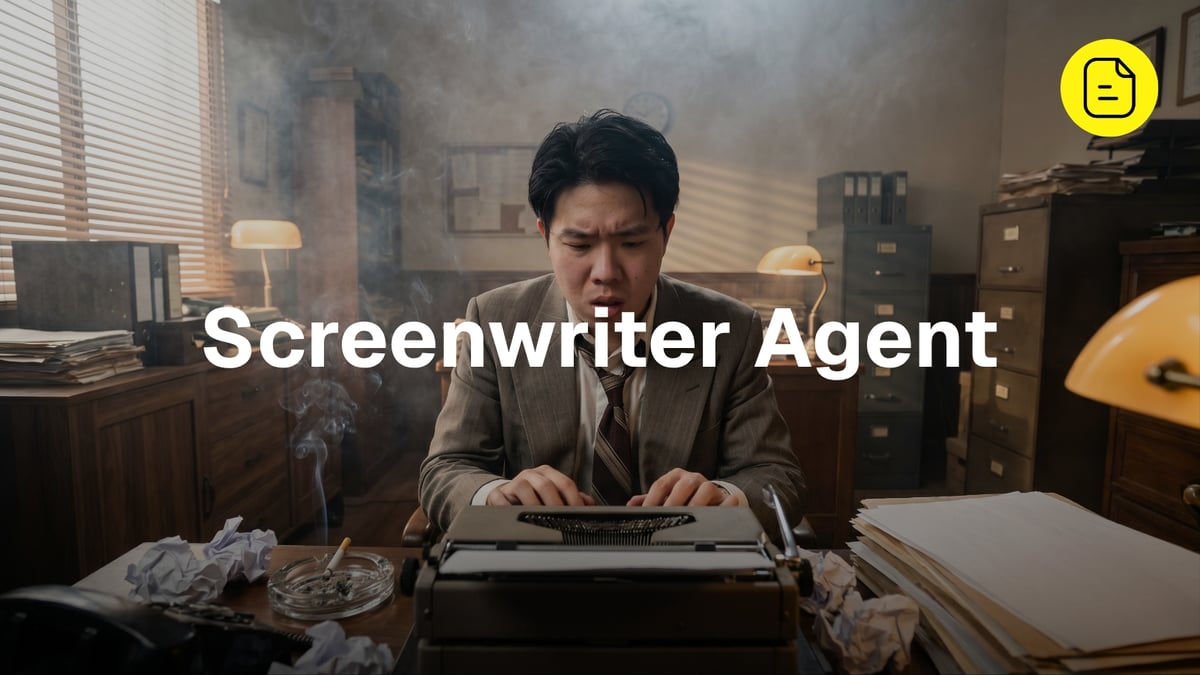
Meet the Screenwriter Agent
# Agents
# Creative Workflows
Every film crew needs a script. This is who writes it.

Chung Puo Chong
This whole thing started in one of my usual 1:1 catch‑ups with Theo. I mentioned I’d been deep in agent work, and he casually said it’d be great to have agents that function like a real film crew.
We were on to something.
That’s how we came up with the idea of Film Crew agents. And just like in Hollywood, the starting point was the Screenwriter, because nothing else can exist without a script. It is the foundation everyone else stands on.
If the scene logic is thin or the dialogue falls flat, no amount of clever design or beautiful imagery can patch the holes. So the only real starting point was to ask the hard questions:
What makes a script feel alive?
What gives the rest of the crew something solid to build on?
That’s where the Screenwriter Agent had to earn its place.
Ask only stupid questions
With this agent, and all subsequent ones — I had to figure out a couple of key things:
- What do they actually do?
- What are they responsible for?
- What is the language they use?
- What do they care about enough to be annoying about it?
So I turned to my two biggest allies: AI and stupid questions.
It opened my eyes as to what a Screenwriter obsesses over: structure, pacing, character intention, scene logic, emotional payoff, and whether a moment earns its place on the page. There is an invisible architecture that makes a story hold together long before anyone else touches it.
The scene has to earn its place
From the get-go I knew the Screenwriter agent couldn’t just be a useful line generator in screenplay format. That is how you end up with very tidy nonsense.
A proper screenwriter is making creative decisions all the time. Scene by scene, they are carving out intent, conflict, rhythm, what gets revealed, and what gets held back. If a character smirks, it should mean something. If someone avoids answering, that should tighten the screw.
Done properly, even the smallest gestures or shortest lines can reveal motive, shift power, and move the story forward. None of that is decoration. That is the writing.
And behind each of those choices are far bigger questions. Did that line make sense? Who wants what? What is getting in the way? What changes by the end? If nothing changes, why are we still here?
That gave me a better way into the build.
Put a bit of weight on it
Scenes need pressure. A beat sheet needs movement. A treatment needs a spine. Dialogue needs subtext, not people politely stating their motivations like they are in HR. The screenwriter does more than just “write the story”, they have to prevent the film from collapsing into scenes that sound nice but do nothing.
This weight had to show up in the writing. Characters had to sound like real people. They could not want one thing in one scene and conveniently want another later because the plot needed help. All the while — tone and story logic had to hold. And if a scene was not adding pressure, revealing character, or changing the situation, it was dead weight.
In turn, that shaped the guardrails. The Screenwriter was barred from indulging in literary prose, hiding key meaning in internal monologues, or inventing formatting habits nobody in production would thank you for. It had to write what could actually be seen and heard. Visual, clean, and shootable.
Writing for people who still have to make the thing
What I liked about building this one was that it forced me to think beyond the page.
I put myself into the shoes of an actual screenwriter and thought about who they would have to interact with — directors, actors, production crews, cameramen — people who have to turn text into something tangible.
In other words, the agent had to employ simple language to help the next person understand what is happening on-screen, and what is needed to do their job.
Scenes should start late and end early. Action lines should do their job and leave. Character intros should tell you something useful fast. Timing notes help. Over-explaining does not.
That’s how the pieces started falling into place. The agent now had structure built in, delivered scenes with intent, crafted sharper dialogue, and left notes that were blunt enough to be useful. Which, frankly, is about all you can ask from a screenwriter, human or otherwise.
Using the Screenwriter
The Screenwriter can do more than write a scene from nothing. It can help shape the idea, find what is not working, and then keep pushing the script until the structure, pacing, and tone are doing their jobs.
Here are three ways we tested it.
1. Generating from scratch
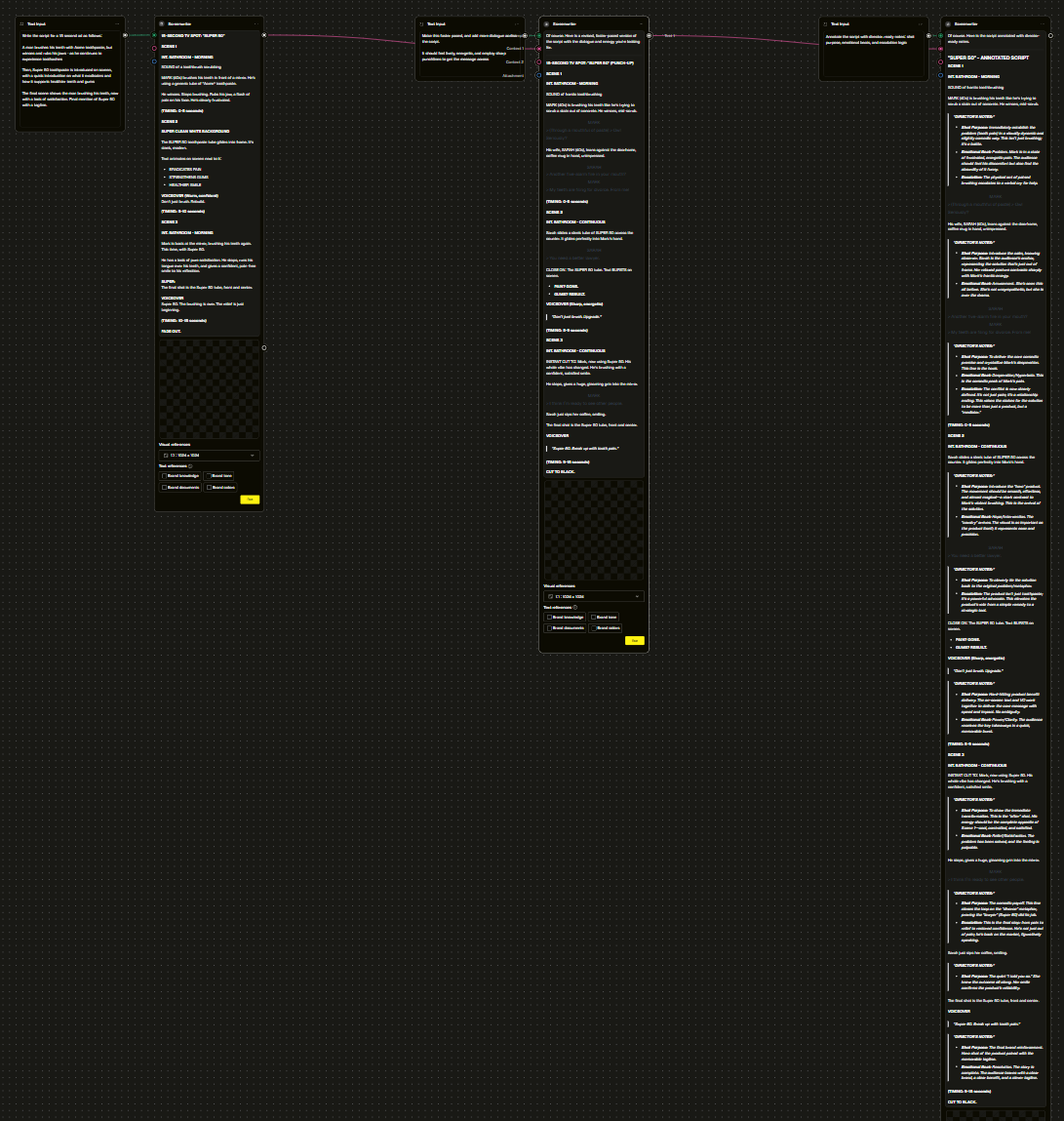
For the first test, we started by giving it the basis of a simple toothpaste ad: someone has tooth pain, discovers a better product, and ends with relief.
The Screenwriter turned that into a 15-second script with clear scenes, timing, dialogue, product moments, and a final tagline. From there, we pushed it to be faster, sharper, and more comedic, before asking it to annotate the script with shot purpose and emotional beats.
Prompt tip: Don’t just say “write me an ad.” Tell it what happens in the beginning, middle, and end, how long the ad should be, and what kind of feeling you want. After the first version, ask for a stronger second pass instead of trying to get everything perfect at once.
2. Reviewing an existing script
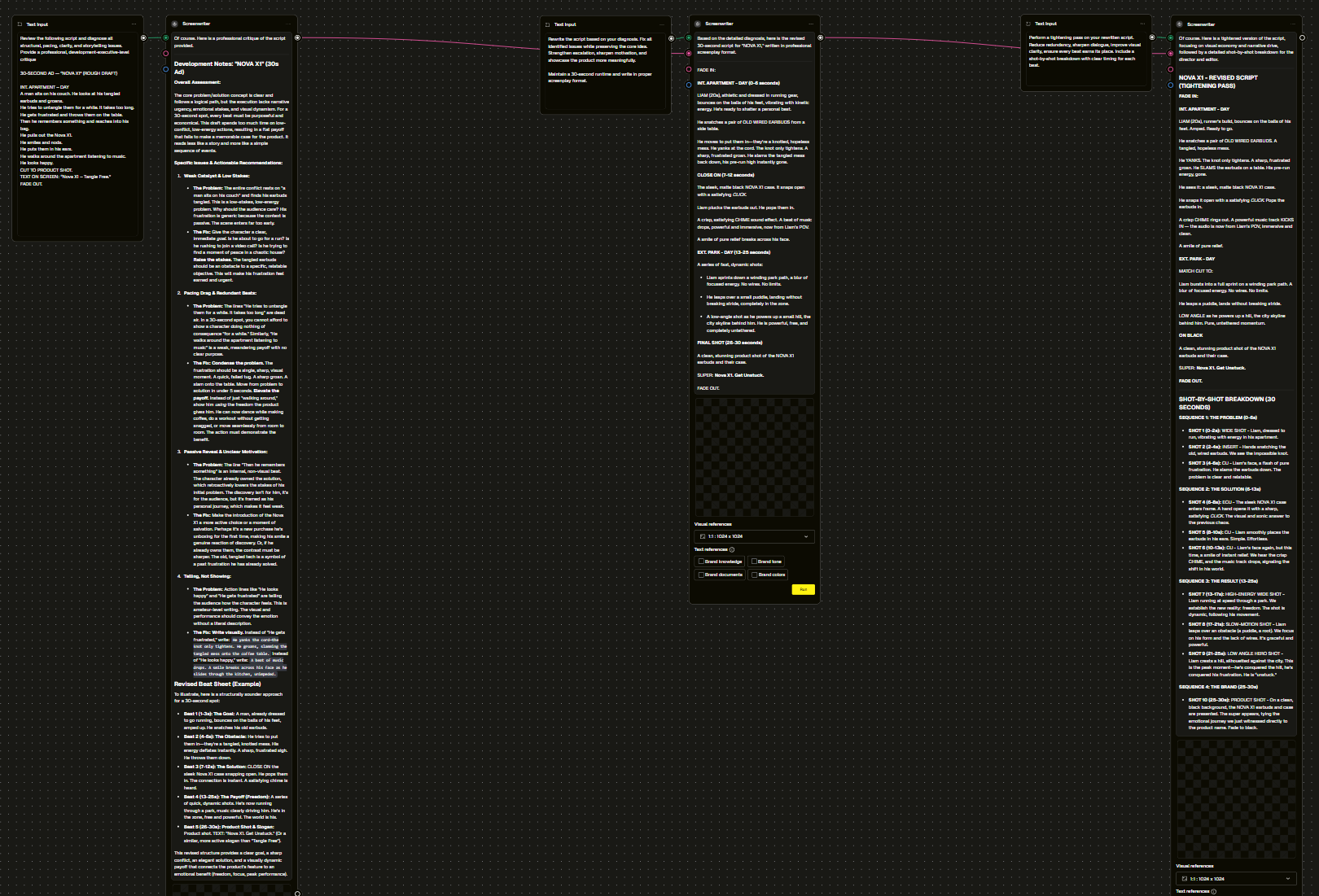
For the second test, we gave the Screenwriter a rough 30-second ad and asked it to diagnose what was broken.
This is where it became useful beyond writing. Instead of just saying whether the script was “good” or “bad,” it broke down what was not working. The problem was too passive. The character had no clear urgency. Some actions dragged on for too long.
The agent then rewrote the script while preserving the core idea, before tightening it into a cleaner version with a shot-by-shot breakdown.
Prompt tip: When asking it to review something, ask for the problems first and the rewrite after. That way, you can see what it is fixing instead of getting a new version with no explanation. Also, tell it what you want checked: pacing, clarity, motivation, product reveal, dialogue, or anything else that matters to you.
3. Iteration
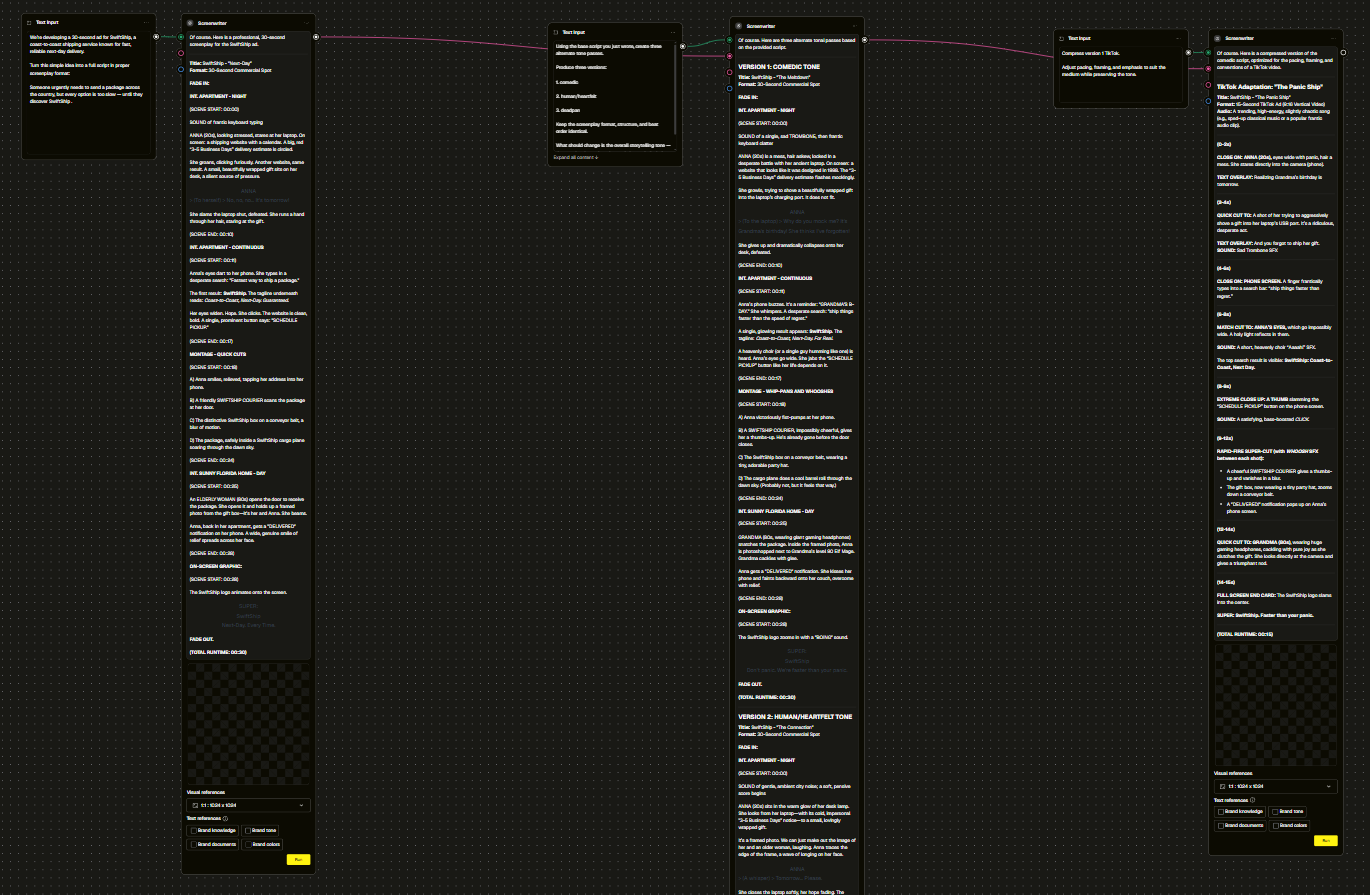
For the third test, we used the Screenwriter to see how far one idea could stretch.
We started with a shipping service ad about someone who urgently needs to send a package across the country. The agent built that into a full 30-second script. Then, instead of starting over, we asked it to create different tone versions of the same idea: comedic, human/heartfelt, and deadpan.
That was useful because it kept the bones of the ad intact while changing the feel. The same basic story could become ridiculous, emotional, or dry and understated, depending on how the scenes were written.
After that, we pushed one version further by adapting it for TikTok, changing the pacing, framing, sound cues, and emphasis for a shorter vertical format.
Prompt tip: When asking for different versions, be clear about what should stay the same. For example, keep the same story order, but change the tone. Or keep the same idea, but make it shorter for social media reels. This stops the agent from wandering too far away from what you actually need.
Get the Agent
Copy the Screenwriter agent into your workspace using this Agent ID:
15b95480-2c69-4674-b588-c99dc32ae332
Sign in or Join the community
Surprising you with what creativity can do.

Create an account
Surprising you with what creativity can do.
4
Comments (0)
Popular
