
Creative Teams
November 14, 2025
Unpacking The Creative Process With Agents
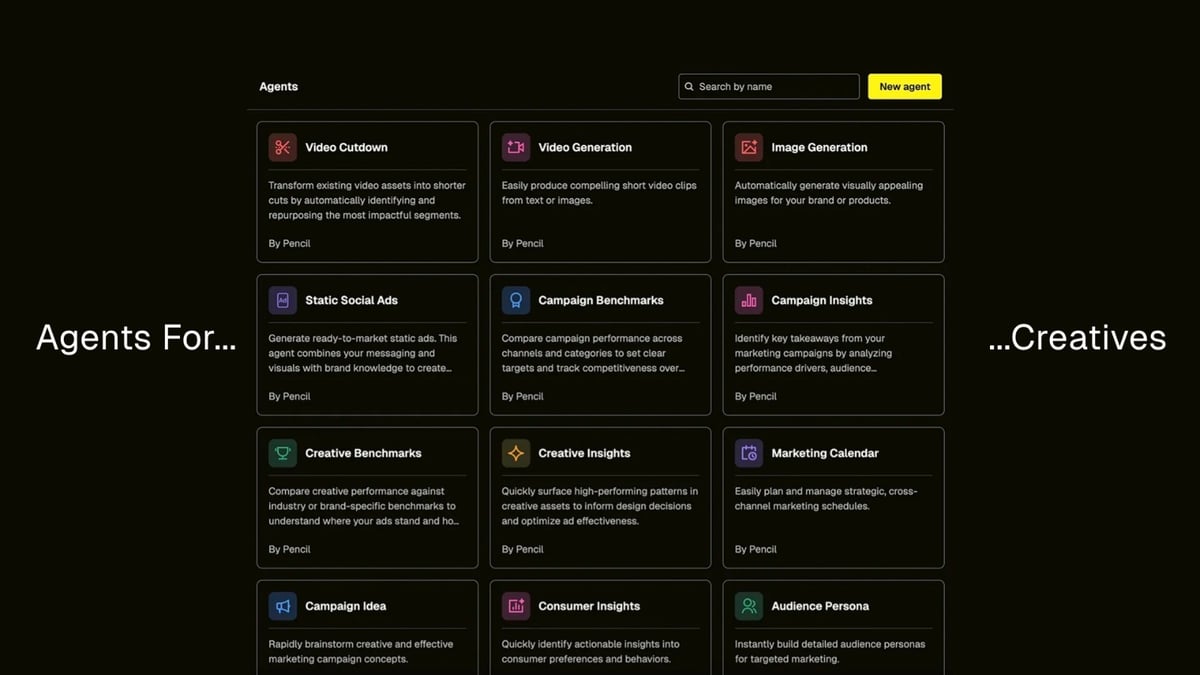
# Agents
# Creative Workflows
Ideation can be a struggle as it is not always linear. Here’s how we tackle it.

Chung Puo Chong
Great ads begin as ideas that speak to the truths your audience lives by. Yet, figuring out where to start this creative journey isn't always obvious and can be a real challenge.
Pencil’s dedicated agents were built for this exact reason. They help you to uncover insights, create personas, develop concepts, and bring it to life with design and copy — with each stage building on the strategic groundwork that preceded it.
Each step explored below comes with a sample prompt and output. You can use the prompts as a foundation, building and even improving upon them for yourself.
Prompt Example Image  | Output Example Image 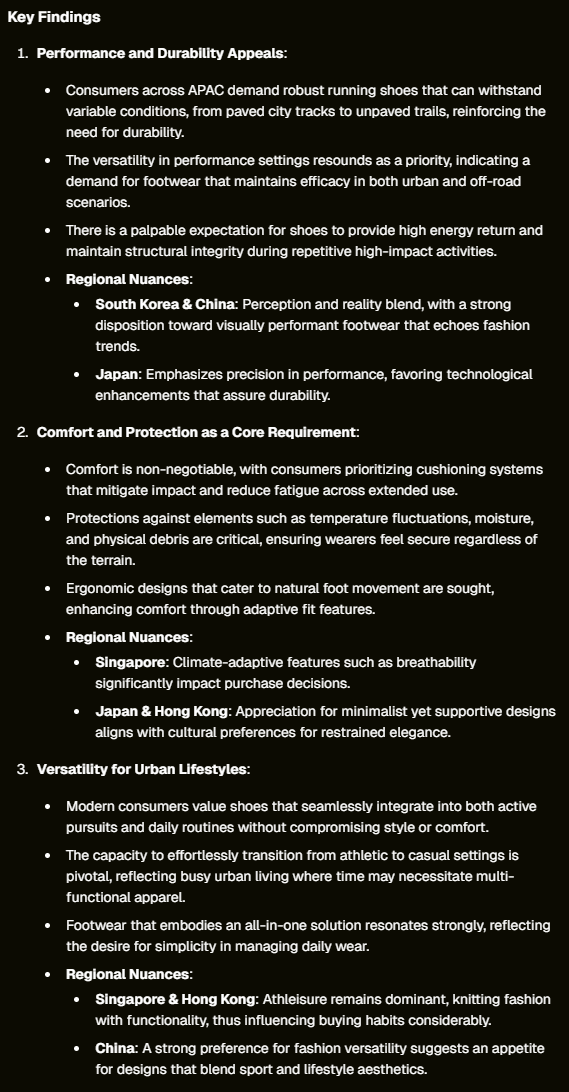 |
Step 1: Consumer Insights Agent
You know the saying — business before pleasure? That applies here. Before we get to enjoy the fun of brainstorming concepts, ideas or taglines, we’ll first need to dig deep into the minds of the consumer. This is why we always kick things off with the Consumer Insights Agent; it helps us discover the underlying motivations and unmet needs of consumers, allowing teams to move beyond generic messaging by delving into real human tensions and desires. These insights act as springboards for concept development by turning observations into emotionally resonant narratives that engage the audience. Prompting Tips: Defining the Brief Objective: Clearly articulate the purpose or objective. The more comprehensive the information, the more relevant the output. Varying Insights: Specify the type of insights needed—whether emotional, behavioral, or cultural—and set parameters like the number, word count, or format. This helps shape the output to match your workflow and facilitates easy scanning and selection. Maintaining Flexibility: When unsure of the specific insights required, explore broader consumer aspects such as beliefs, cultural values, and decision-making processes. This approach broadens the scope and enriches the insights obtained. A good practice is to include as much relevant information about the brief in the prompt to ensure the agent's output aligns with campaign needs. Keep in mind that insights should be brand and product-agnostic. We are still at the research stage, so nothing about insights should contain any mention of brand or product-related information. | |
Prompt Example Image  | Output Example Image 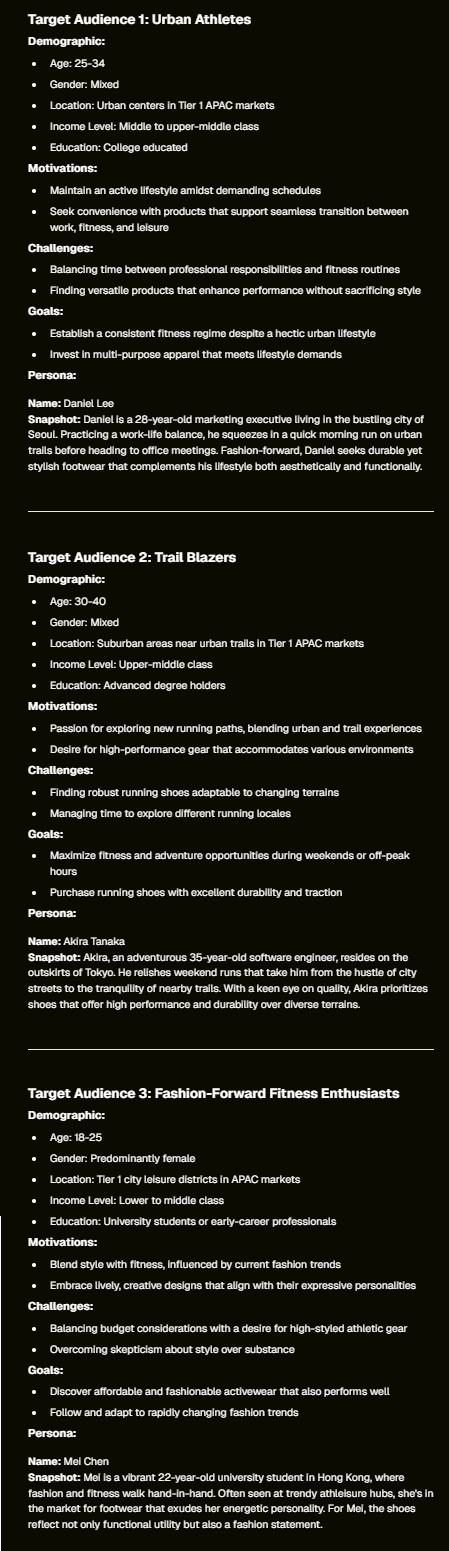 |
Step 2: Audience Persona Agent With our consumer insights in hand, it’s time to find out who the consumer actually is. Now, we turn to the Audience Persona Agent to develop a clear picture of our target audience, and bring them to life through personas. Target audiences should cover a broad spectrum of individuals, while personas delve deeper into aspects such as mindset, needs, and motivations beyond basic demographics. Prompting Tips: Emotional and Contextual Depth: Mention emotional drivers and situational contexts to ensure each persona feels realistic and useful. Incorporating fields such as hobbies, challenges, fears, and spending habits helps construct a comprehensive and relatable persona. Broad yet Insightful Scoping: Avoid laying down overly prescriptive parameters to broaden the range of target audiences generated. The goal is to uncover segments and personas that might offer fresh or unexpected relevance. Highlighting Relevant Insights: Not every consumer insight the agent presents will be relevant. Be picky and select only the most relevant ones.
Dig Deeper: Move beyond surface-level traits to illustrate how personas think, what they value, and what drives their decisions. Traits like “they want to be seen and heard” or “they value authenticity” can be applied to plenty of people. You can experiment with different ways of describing your persona — whether as a short biographical description, a day-in-the-life narrative, or a monologue. You don’t need to stick to structured bullet points or paragraphs only. | |
Prompt Example Image
 | Output Example Image 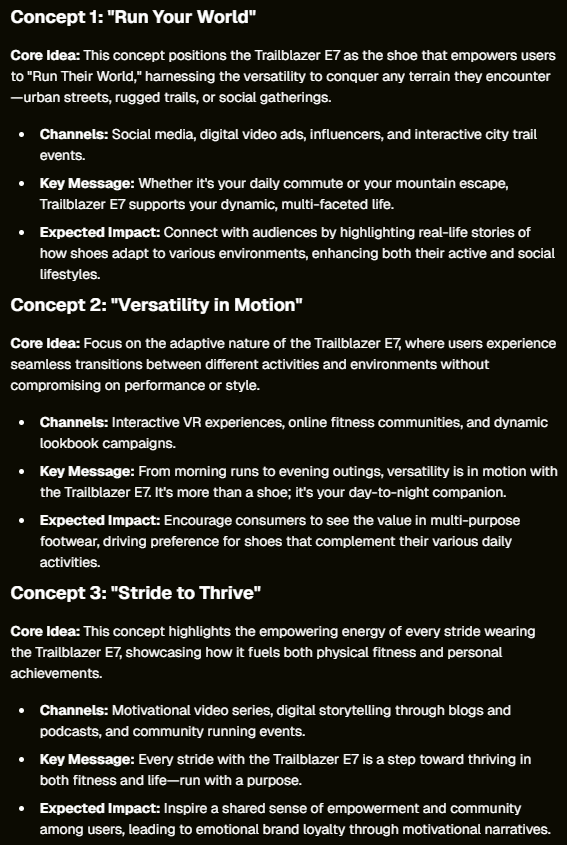 |
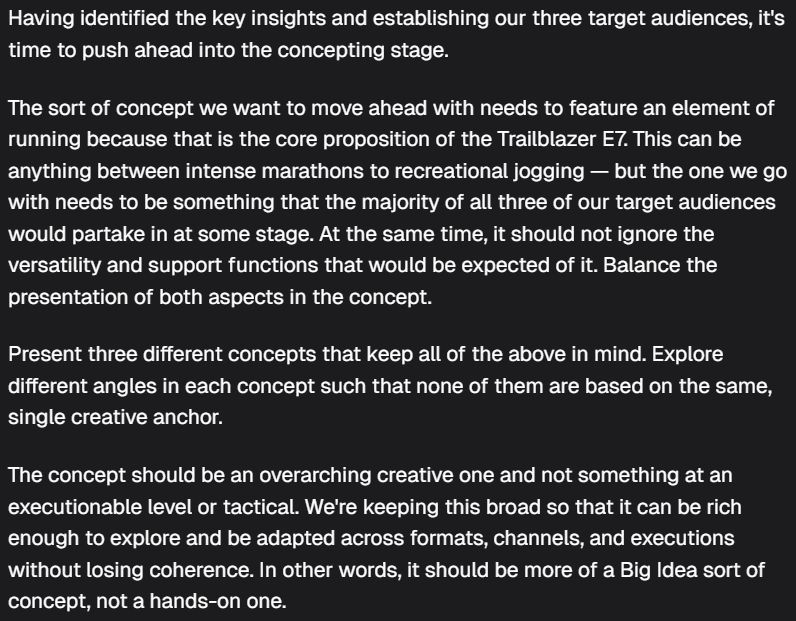
Step 3A: Campaign Idea Agent - Concept Generation The fun is about to begin. Having our insights and knowing who we’re speaking to means we can finally start to get creative. Concept Generation begins with the Campaign Idea Agent, where your selected consumer insights and audience persona data becomes the foundation of creative concepts. These concepts are more than just ideas; they are imaginative interpretations of truths that effectively market a brand campaign. A robust concept should be easy to understand yet rich enough to adapt across various formats, channels, and executions without losing coherence. Additionally, a strong concept resonates emotionally, provides strategic clarity, and aligns with the target audience’s mindset. Prompting Tips: Guiding Concept Development: If initial concepts do not align with your vision, guide the agent by clarifying your expectations, such as:
“The concept should be an overarching creative one and not something at an executionable level or tactical.” Setting Parameters: Clearly establish any compulsories or requirements for the concept. This maintains realistic boundaries that align the output with both the brief and the target audience. If there are no creative limitations, encourage a broader range such as: “We do not have any creative limitations, so feel free to explore a broader range of ideas, and include some potentially unconventional ones.” Ensuring Unique Concepts: Scratch beneath the surface and you may find that some concepts are generated based on the same idea or creative insight. You can avoid this by telling the agent you want all concepts to be distinctly different, with each one based on a different insight. Tightening It Up: Concepts might initially be unpolished, missing out on key unique selling points or focusing on secondary features. Guide the agent back on track with prompts like:
a. “We do not want to focus on the aesthetics, but the memory foam and cushioning. The concept should centre around this aspect.” b. “The concept may not resonate as strongly with one persona. Change the core idea and/or description to ensure it touches on the motivations and challenges faced by all three of them.” c. “The core insight of needing the shoe to support both athletic and leisurely activity is not reflected strongly enough. Rework the concept and title so that it better reflects both the target audiences’ desires or needs, and the foundational benefit of the product.” | |
Prompt Example Image 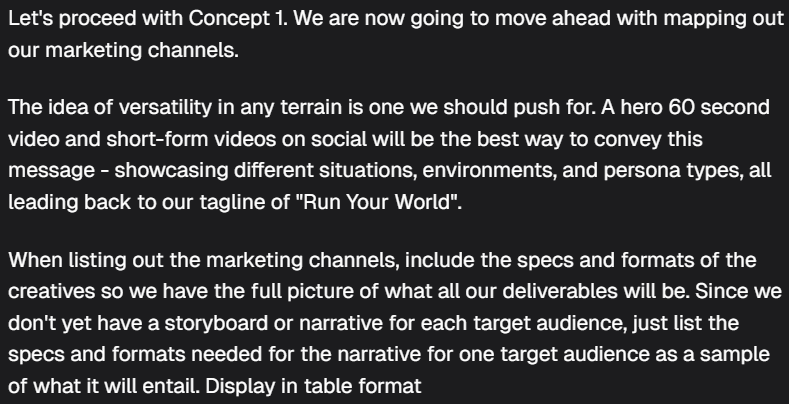 | Output Example Image 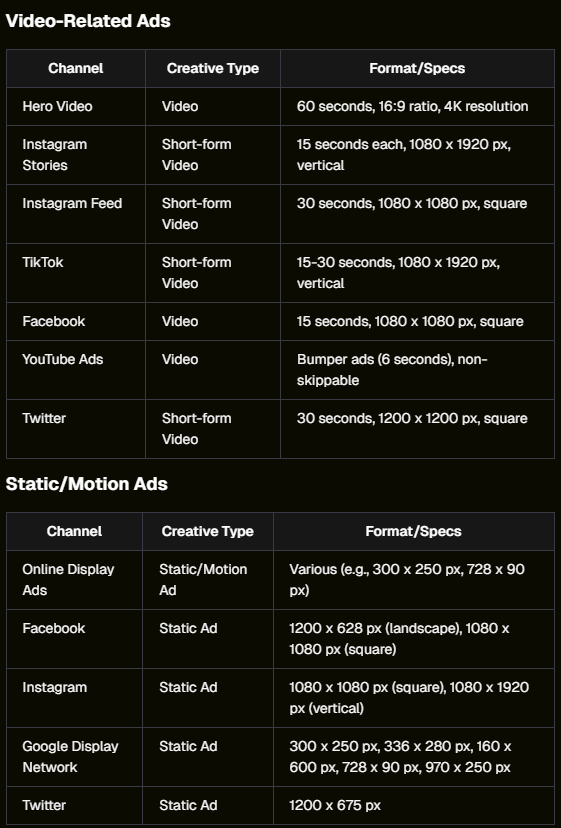 |
Step 3B: Campaign Idea Agent - Marketing Channels Staying in the Campaign Idea Agent, we now move towards defining the appropriate marketing channels, which also helps us to establish the project's deliverables. This part is all about determining the most appropriate channels and formats, such as static imagery or videos. Prompting Tips: Specificity in Channel Selection: If you know which channels you will utilize, list them and request the number of assets and their formats. This clarity helps tailor the strategy to the project’s needs. Comprehensive Asset Overview: Specify the number of creative assets required per target audience or persona. This approach provides a more comprehensive understanding of the total assets needed. Once you've selected and possibly refined your concept to suit the brief, identify the most suitable platforms and formats. Here are some ways to prompt the agent:
| |
Prompt Example Image 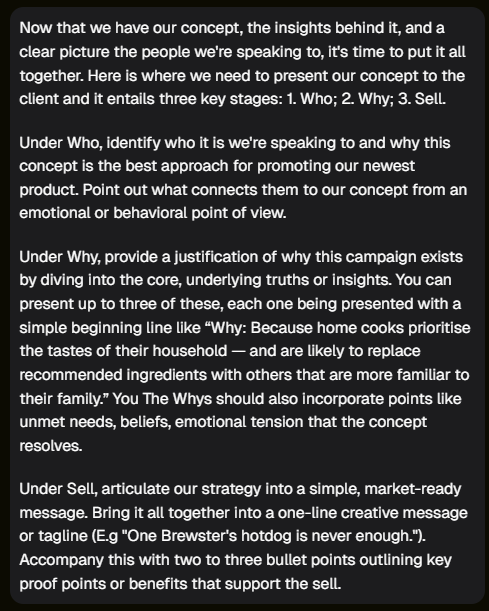 | Output Example Image  |
Step 3C: Campaign Idea Agent - Who, Why, Sell You’re convinced that you’ve got an amazing concept that the client will love. But do you know that for sure? The "Who, Why, Sell" framework will help you improve the odds of winning them over with your concept. By tying the insights, target consumer personas, and concepts together, it provides proof that the idea you’re presenting is grounded in what matters to the brand and to the people you’re trying to reach. Here’s what we are looking to achieve in this phase: Who: Mapping identified marketing channels directly to target audiences, ensuring alignment with their media consumption habits and behaviors. Why: Articulating the appeal of the concept, demonstrating its relevance and resonance with the target audience on a deeper level. Sell: Highlighting and connecting essential product or service benefits and features to the target audience’s needs and preferences. Prompting Tips: Segmented Instructions: Clearly delineate instructions for each aspect of Who, Why, Sell. Each serves a distinct purpose and requires tailored guidance. Formatting for Readability: Specify that the output is intended for a pitch or slide deck, prompting the learning model to present the information in a structured, easily digestible format. Expanding on the Why: To further build a case for your concept, you can tell the agent that the Why needs to answer a number of questions. For instance:
Connecting All the Dots: Be clear that the goal is to bring together insights, concepts, and target audiences together to demonstrate that the idea is grounded in real consumer challenges, desires, and decision-making contexts. The "Who" and "Why" sections should steer clear of overt product-benefit mentions, instead providing insight into the audience’s mindset, thoughts, and behaviors, and connecting back to the primary concept. Each justification in the "Why" section should seamlessly extend the audience’s worldview. Should any of these justifications feel inconsistent or disconnected from the audience's habits, beliefs, or tensions, revisit and refine the "Who" prompt to ensure better alignment. | |
Prompt Example Image  | Output Example Image  |
Step 3D: Campaign Idea Agent - Visual Development Your concepts are one step closer to coming alive at the Visual Development stage. This phase typically begins by ideating one or two hero images or scenarios that depict the target audience interacting positively with the product or service. The goal is to create vibrant image descriptions, enabling designers to craft prompts for image generation effectively. Prompting Tips: Frontloading Mandatories: Begin by listing elements of the image or composition details you want to capture in the visual. This might include color palettes, textures, framing, or product interactions. Strengthening Relevance: Instruct the agent to refer back to insights from the Who, Why, and Sell sections for more grounded and accurate scenario ideas, as these are anchored in truths already uncovered. Expanding Possibilities: Set the number of visuals you wish to start with, exploring multiple scenarios per target audience or persona. Consider broader elements like time of day or season. You can provide more detailed instructions for output generation. For instance:
| |
Prompt Example Image 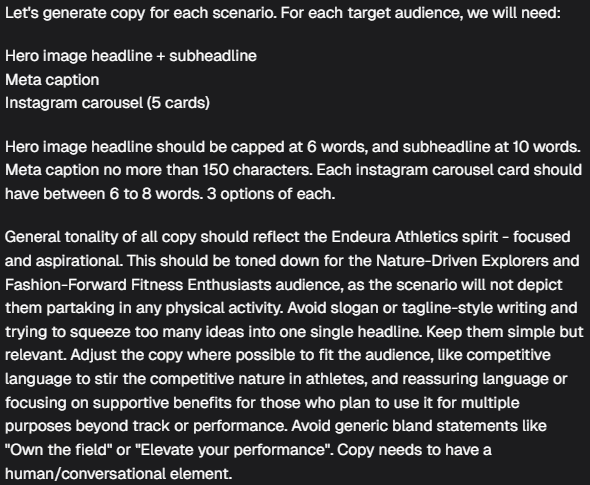 | Output Example Image 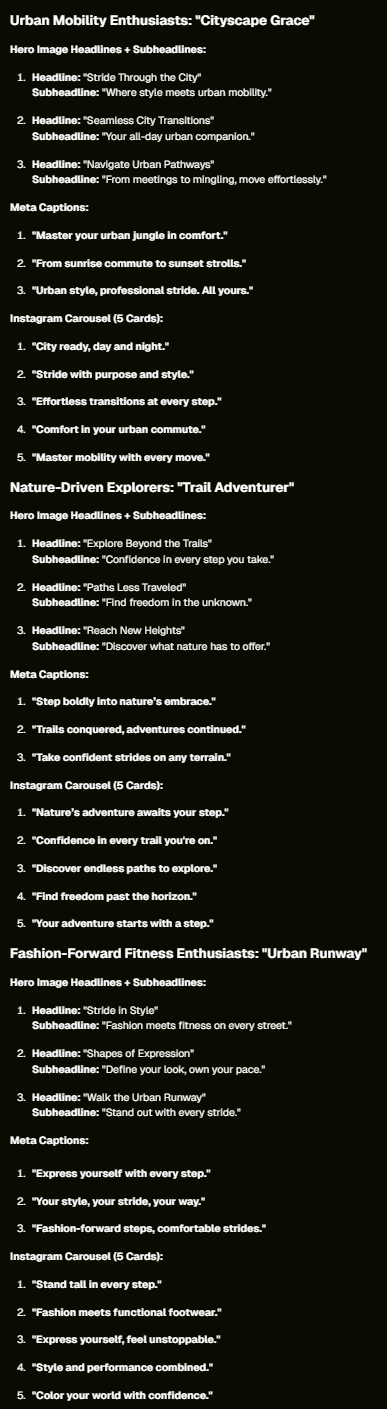 |
Step 4: Text Tool
Once insights, audience personas, concepts, and visual development are done, you come into the final stretch with copy generation. The importance of specific and clear feedback cannot be overstated; understanding what doesn’t work, why, and how to correct it is essential for achieving high-quality outputs. Prompting Tips: Set Parameters Upfront: Establishing word or character limits from the beginning helps ensure drafts meet specifications, avoiding the need for later adjustments. Reinforce Tone of Voice: Even when documented, reiterating your brand's Tone of Voice within prompts is vital to prevent the LLM from generating generic outputs. Consistency in style is key. Highlight Do’s and Don’ts: Clearly specify what to include in the copy as well as what to avoid. Negative examples can be as instructive as positive guidelines. Defining What Is Good: Providing examples of exemplary copy (three to five is ideal) can further refine the LLM's understanding of what good content looks like. This added context aids in generating more targeted and nuanced results. In general, copy prompts should address two main aspects: 1. Requirements: Specify the number of options needed, platforms, and character or word limits. 2. Instructions: Outline tone, language, style, or formatting. Detailed instructions significantly impact output quality, ensuring it aligns with brand expectations. Rectifying "AI Copy" Characteristics: Initial copy drafts often exhibit markers of artificiality—overuse of vague abstractions, forced alliteration, crammed ideas, and dual two-word phrases. Overcoming these involves providing feedback, such as specifying the need for concrete benefits, action, and context over abstract metaphors. Sample feedback prompts:
| |
Got An Idea? Don’t Be Afraid To Try It
There is no fixed or right way when it comes to writing your prompts. If the output does not work for you for any reason whatsoever, bring it into your prompt and let the platform know your feedback.
You don’t have to propose a fix or workaround, sometimes all it takes is to highlight what you liked or didn't like, and let the agents handle the rest. It is unlikely that the process will ever be straightforward, and that is absolutely normal.
Always remember, the platform is there to help you. If an idea pops into your head, tell the agent to try something with it. You never know what could happen.
Sign in or Join the community
Surprising you with what creativity can do.

Create an account
Surprising you with what creativity can do.
Like
Comments (0)
Popular

Dive in
Related
Blog
Agents in Feed: A Practical Guide for Creative Teams
By Juliette Suvitha • Nov 28th, 2025 • Views 361
57:10
Video
HUMANS + AI: The Future of Creative Work, with Ryan Paulson
By Tom Edwards • Jan 5th, 2026 • Views 35
Blog
Agents in Feed: A Practical Guide for Creative Teams
By Juliette Suvitha • Nov 28th, 2025 • Views 361
57:10
Video
HUMANS + AI: The Future of Creative Work, with Ryan Paulson
By Tom Edwards • Jan 5th, 2026 • Views 35