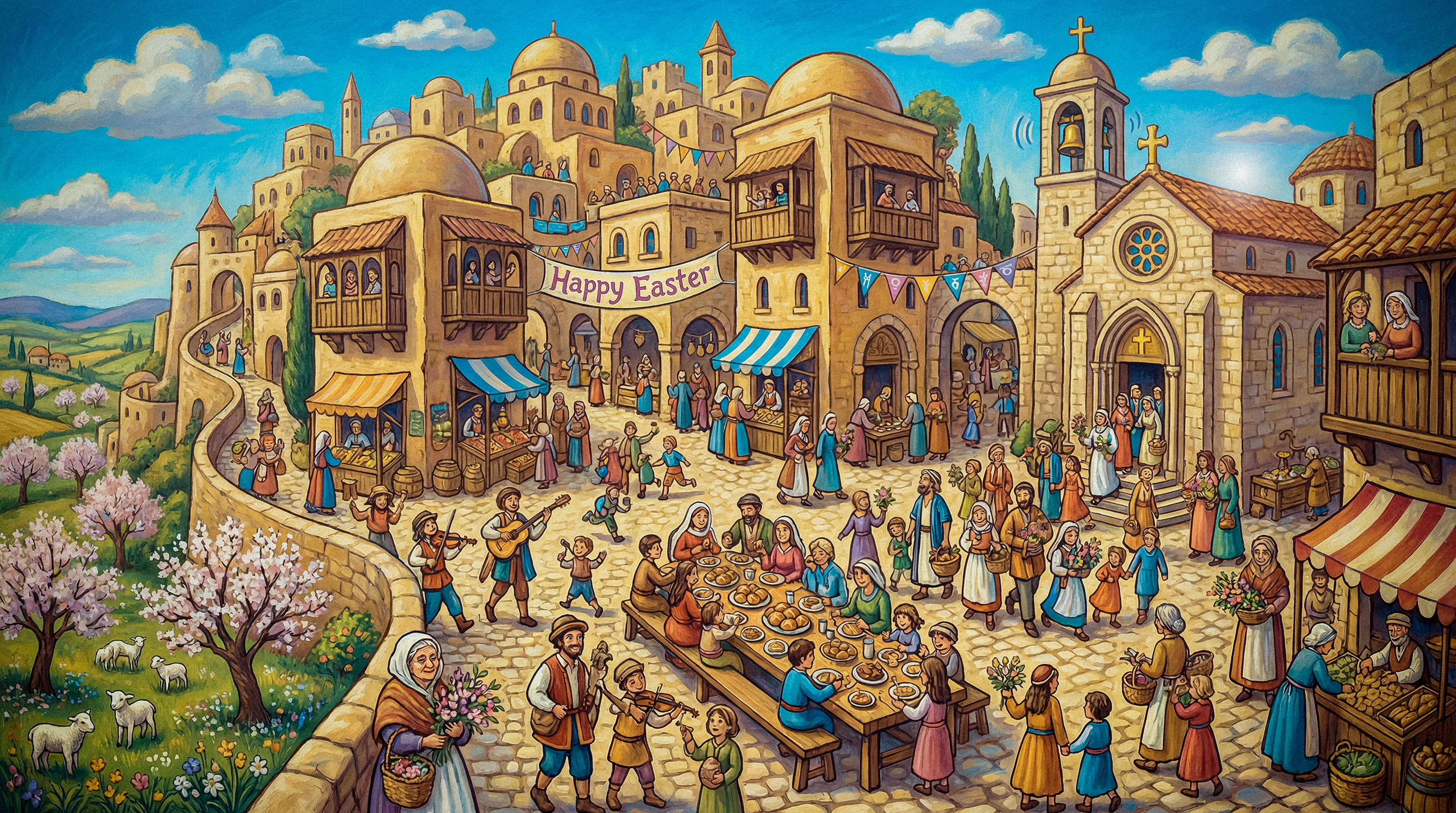
For cultural Christians around the world, Easter is a much-needed respite after a gruelling first quarter - a hiatus to unwind, and recharge emotionally over some quality time spent relaxing and recreating with family and loved ones.
But for billions of practising Christians, Easter - which falls on the 5th of April this year - is actually the most important occasion on the liturgical calendar. It all begins with a week of accumulating solemnity, known as Holy Week.
Holy Week is an annual re-living of the final days of Jesus's life, compressed into a sequence of sacred rituals. Palm Sunday marks his arrival in Jerusalem to cheering crowds. By Maundy Thursday, the mood has shifted entirely: a last meal with his disciples, a betrayal, a garden vigil. Good Friday commemorates the harrowing moment of the crucifixion itself. Then comes Holy Saturday; a day of profound quietude.
All of this culminates in Easter Sunday - the day of the Resurrection. In Christian theology, this is the historic linchpin upon which the entire faith turns. Without it, as the Apostle Paul wrote, the faith is "in vain."
Easter celebrations take remarkably different forms across the world. Some Orthodox Christian communities observe the occasion with a dramatic midnight Paschal liturgy characterised by one of Christianity’s oldest call-and-response traditions. The night air rings with the faithful’s ardent proclamations of, "Christos anesti!" (Christ is risen!), to which others rapturously respond: "Alithos anesti!" (He is risen indeed!).
In Ethiopia, Fasika is preceded by a 55-day fast. In parts of the Philippines, devotees undergo literal re-enactments of the crucifixion! In countries like the UK, Australia and South Africa, however, the day is more likely to involve a morning church service for practising Christians, followed by a laid-back gathering featuring a banquet of hot cross buns and a roast.
And then of course, there are the Easter eggs. In many families, children wake up to find that a certain mythical rabbit has hidden chocolate eggs and other treats around the house and garden. Some families go all out with elaborate treasure hunts and cryptic clues. It's one of the most joyful secular traditions of the season, and for many people that's the heart of what Easter Sunday actually looks like.
For those working on seasonal campaigns, Easter is one of the most visually codified occasions on the calendar, and one of the easiest to flatten into technicolour cliché. The richer creative territory sits in the full spectrum of how people actually experience it: as a holy day, a holiday, or both. Work that holds that range tends to resonate more deeply.
It is also worth knowing that for colleagues who observe, this is not simply a holiday. Good Friday is a day of mourning. Some Christians fast for Lent in the weeks preceding Easter. Some people will be attending lengthy services at various intervals throughout the Easter period. Others will want to take some time to meditate and contemplate the gravity of Jesus’ sacrifice, and what the day represents. As with other religious traditions, an awareness of the rhythm and practices of these observances is always appreciated.
Happy Easter, from everyone at Pencil!